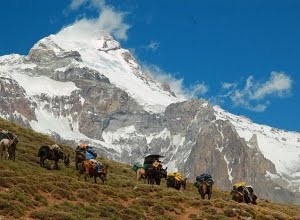
Bryan called and his group just arrived at base camp, 13,800 ft. He said they had a “great” beef BBQ last night that was prepared by the porters. They were climbing strong so expect to have Christmas day off at the next (higher) camp site. He is doing well so far!
Page 13 of 13
Just about to leave Mendoza for Penitentes. One more night in a real bed. Adios
Just got to the hotel in mendoza. Pretty swanky. I’m sure they’ll love us in weeks
Estoy en Santiago Chile
11 days and counting til I take off.
Here’s the day by day itinerary
Aconcagua Ameghino Valley Upper Guanacos Traverse Full Itinerary
-
Day 1
Group meets in Mendoza, Argentina. Equipment check and afternoon briefing will be at the hotel. For dinner we will have a chance to taste fine Argentinean cuisine and wine.
-
Day 2
Drive west from Mendoza to Penitentes ski area at 8,500’. Our drive winds along the Rio Mendoza deep into the heart of the rugged Andes mountains where we begin our acclimatization in Penitentes. Afternoon hike is recommended, though optional.
-
Day 3 – 5
Approach to Base Camp. Hike up the Vacas and Ameghino Valleys to Base Camp. Mules will carry our gear. Here we begin the route, which was established in 1934 by a Polish Expedition. Even today this eastern approach to the mountain is not as heavily traveled as the Normal Route. After three days of spectacular, colorful, high desert scenery we reach our Base Camp, at 13,800’. The hike to Base Camp is approximately 40 miles and gives us the perfect chance to begin our acclimatization.
-
Day 6
Rest and acclimatization day at Base Camp. We want everyone to have the best possible chance to make the summit. The most effective way to do this is to take the time to acclimatize to the low oxygen environment. We will incorporate rest days into our schedule and climb in traditional expedition style. We will be carrying loads up to the next camp and returning to sleep below at the previous camp. The next day we will move to the higher camp. This is an excellent method of acclimatization, which is our main focus throughout your expedition.
-
Day 7
Carry a load to Camp I, at 16,300’. The route goes up a gentle trail on the rocky moraine-covered Relinchos Glacier situated between Cerro Aconcagua and Cerro Ameghino. Here we will be able to see Nieve Penitentes, unique snow and ice formations created by the direct sun. Return to Base Camp.
-
Day 8
Leave Base Camp. Move to Camp I
-
Day 9
Carry a load to Camp II, at 17,500’. Fantastic view of the Polish Glacier. We ascend scree slopes to a broad ridge crest where we will establish Camp II. Today we reconnect with our UPPER GUANACOS VALLEY ROUTE! After reaching the Ameghino saddle, a gentle easy traverse takes us to the Guanacos.
-
Day 10
Move to Camp II.
-
Day 11
Move to Camp III, at 17,800’. A carry will not be needed today, since we have already done our short carry most likely the day before. This is an easy day where we traverse from the saddle to the upper Guanacos, elevation gain is minimum. This camp and tactic are key for our success. Using 2 camps at the 17,500’ level we save a day, which can be used later for a rest or a weather day at High Camp. On this particular day, this route creates one of the best upper mountain acclimatization possibilities on Aconcagua. The results are overwhelmingly positive: a team very well acclimatized.
-
Day 12
Carry to High Camp, Piedras Blancas (White Rocks), at 19,200’.
-
Day 13
Move to High Camp, from where we will tackle the summit the next day.
-
Day 14 – 17
Summit! Weather permitting. We leave several days for our summit day in case of poor weather.
-
Day 18
Descend down the Normal Route, all the way to Plaza de Mulas Base Camp, at 13,800’. This will be quite exciting since we descend a different side of the mountain.
-
Day 19
Descend the Horcones Valley with its impressive views of Aconcagua’s South Face. Mules carry our gear. Spend the night in Penitentes.
-
Day 20
Drive back to Mendoza. Evening banquet with your team. Spend night in Mendoza.
-
Next Day
Fly home or continue traveling in South America.
Trip guided by Aventuras Patagonicas http://patagonicas.com/

New DSB Mountaineering logo. Thanks Nick!
Long time… No update
In less than five weeks, I will be in Argentina doing a final gear check prior to heading out on a ball busting three week journey up Aconcagua. I think I have the majority of the gear I’ll need for the trip, but I’m sure I’ll impulse buy a few things here and there before I take off.
More for me than anything else, but here’s my current gear list for the trip:
Scarpa Inverno double plastic mountaineering boots w/ high altitude liner
Asolo GTX Fugitive hiking boots
Feathered Friends down booties
Outdoor Research Expedition Gaiters
Outdoor Research Mentor Jacket hard shell
Mountain Hardwear Syncrho soft shell
Mountain Hardwear Windstopper Tech Jacket
Patagonia Fleece Retro Jacket
Feathered Friends Icefall Parka
Feathered Friends Hyperion Jacket
Arc’Teryx expedition weight baselayer
Misc soft shell pullovers and fleece tops
First Ascent Igniter Primaloft pants
Mountain Hardwear hard shell pants
Mountain Hardwear soft shell pants
Outdoor Research Meteor Mitt
First Ascent Guide Gloves
Outdoor Research PL 150 Liner
Mountain Hardwear Medusa Mitt
Mountain Hardwear Fulcrum Gloves
Grivel G12 Crampons
Black Diamond Raven Ice Axe 65mm
Black Diamond Venom Ice Axe w/ hammer 57mm
Black Diamond Half Dome helmet
Black Diamond Momentum AL harness
Black Diamond Trail Compact trekking poles
Petzl Ascension Ascender (Left & Right)
Gregory Denali Pro pack 106L
Osprey Switch 36 (39L) pack
Petzl Headlamp
SOG Flash II Knife
Feathered Friends Ptarmigan -25F sleeping bag
Closed Cell foam pad
Therm-a-Rest ProLite Plus sleeping pad
North Face Base Camp Duffel bag to put everything in
That’s all the crap I get to lug around with me up and down the mountain, and through several airports. Should be good times.
Now it’s time to put all this junk to use and climb as much as I can for the next 4.5 weeks.
Giddeyup
B
Done!!!!!!!!!!
Today we rocked Mt Rainier. If I barely make sense, bare with me, I’ve basically been awake for 40+hrs and have 14+hrs of climbing mixed into that somewhere.
First off, thanks to Nate, John, & JP at Alpine Ascents for helping to make a truly incredible climb possible. They were pretty killer guides/cooks/coaches and we were lucky to have them.
The itinerary that I posted earlier is pretty close to what we ended up doing. The only edits I’ll make are the lack of consideration I gave to getting any amount of sleep or specific snacks eaten while hiking.
Day 1 was just a long slog from the parking lot at the Paradise Visitors center (5,400 ft) up to Camp Muir (10,000 ft) which is not an all bad vertical gain, considering we’d be staying the night, and pushing for another 1,000 ft the next day. We got into camp about 4:00 and quickly set up shop, got a hot drink in the works and topped off our water bottles. Here, is where I’ll say that the guides really started to shine. They kicked the door down bearing gifts of food – burritos cooked from scratch. I gotta say that I was pretty impressed to be having a meal like that instead of freeze dried whale dick that I was expecting to have. Apparently I was a lumber jacker and sawed serious logs during the night.. I think the guys in the bunk below us were fit to be tide by about 6am.. Oh well, should have brought ear plugs – as suggested by the guides.
Day 2 starts off right with coffee, fresh blueberry pancakes, eggs and bacon. How bad can this deal be one might ask? After wrapping up from breakfast we had a day of “snow skills” which included things like self arrest (stopping yourself if you fall down a hill), the most efficient stepping techniques (who knew that the French would get something right?), crampon use, and avalanche beacon use. Pretty straight forward stuff that ideally you will not have to use. Fortunately, no one had to use any of the safety techniques taught, so that’s a bonus. After class we ascended over the Cowlitz glacier, through Cathedral Gap and up to Ingraham Flats.
On summit night we were supposed to go to bed at 6:00pm and get as much sleep as you could by midnight. I must have climbed that mountain and every possible obstacle or hazard a million times in my head from 6 – 12am. I may have gotten a collective 1-1.5hrs of sleep, but I’m not sure. Suffice it to say, adrenaline is what fueled the first half of the day.
I tried to power down some oatmeal to give me some energy even though I had little if any appetite. After putting on our layers of clothes, head lamps, crampons and roped up, we were off. Disappointment Cleaver was the first obstacle, and quite one at that with 1hr 45 minutes needed to get beyond it. To summarize – 2ft wide ledge on a glacier in many spots, walking over crevasses and using fixed lines to ensure stability when traversing really hairy spots on the trail. Apparently the deal behind Disappointment Cleaver was that original mountaineers believed this to be the summit, and to their incredible dismay when they reached the top of it, they still had a good 2.5-3hrs of climbing (in good conditions) left.
Our breaks were very short lived due to the extremely cold temperatures that were not helped with a ripping wind coming off the mountain causing all sorts of fun. Switch back, after switchback, and steep pitch, we were nearing the summit of Mt Rainier at about 4:45am. Unfortunately we didn’t get to cross the crater rim – something to do with -10F and 60mph+ winds ??? Lame… oh well, we turned around, for what was to be a long slog of descent ahead of us. The upside of not risking the crater rim is that I’m here to tell you about it, sunburn and all 🙂
http://s19.photobucket.com/albums/b187/besus-dsb/Mt%20Rainier%20May%202008/
Photo’s from Brian D.
http://picasaweb.google.com/Sponsor7Summits/MtRainier622008
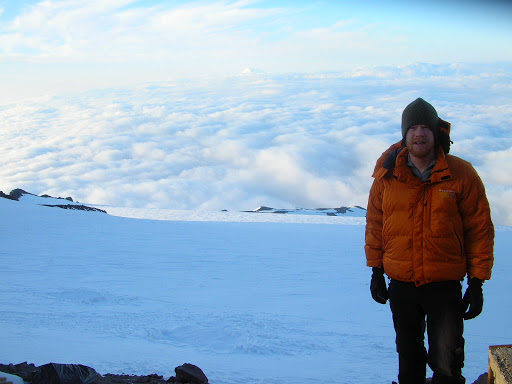
At Camp Muir
Cracks in the glacier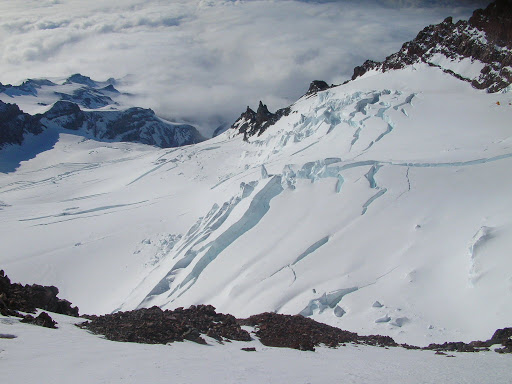
More big cracks. See the tiny trail on top of it? That was the start of our day at 1am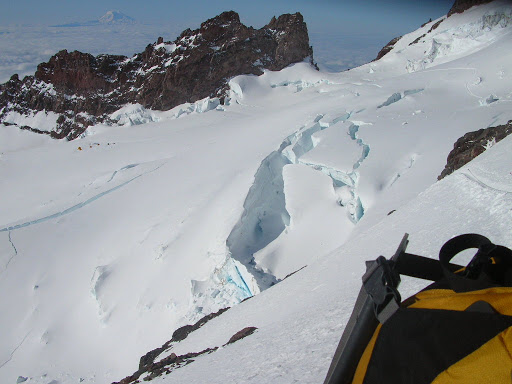
Ready for Rainier? – cont’d
I guess I’ll give a little context to my climb to Mt. Rainier (14,411/ft) next weekend.
I got roped into climbing Rainier by Brian D & Adroc last winter, and before I knew it, I was knee deep in climbing gear (not cheap by the way) and committed to a climb on the 31st of May 2008. The next logical question for anyone that has known me for any amount of time is: OK, What’s next?
Well, my friends, obviously the king shit peak of them all is the end game (Mt Everest – 29,035/ft for those keeping track). However, one does not go from climbing backyard mountains (Mt. Si, Tiger Mountain, Rattlesnake Ridge and Little Si) or even Mt Rainier straight to Chomolungma, unless however you want to go casters up before even reaching base-camp. The roadmap is about 5yrs long for Everest and includes other incredible accomplishments by themselves along the way.
Denali (20,320/ft), which by the way has more elevation gain from base camp to the summit than that of Everest (little known fact), is being targeted right now for about 2 yrs out. I think I’ll do the 8-day Denali prep class offered by Alpine Ascents next summer to make sure that I’m as dialed in as possible.
After Denali, the next logical step as far as I see it, is to tackle Cho-Oyu (26,906/ft) which is a peak reached from Tibet and is over 8000Meters. It gives you the chance to bag a massive peak without the exorbitant cost that goes along with doing Mt Everest with a bit lower risk as well.
If all goes well, on Cho-Oyu and Denali, then there is no reason not to go for the big daddy.
Given that by the time I’ll have done Everest (hopefully), I’ll have the biggest peaks out of the way . I’d love to do the 7 summits over the course of my life if time, money and health permits. I’m going to bag Mt Kosciusko (7,310) this summer while we are in Australia to take down the largest peak on the island. Technically, Australia is part of the continent of Oceania, and therefore the tallest mountain on that continent is in Papua and is named Puncak Jaya (16,024/ft).
Lastly, to address everyone that says: “Do you have a death wish?” “Do you just want to die?” “Why in the world would you do this?” “”
- First, get over it, I’m going.
- Second, you’re just jealous I have the balls to do something few others have. 🙂
- Mt Everest has had a death rate of 4.4% since 1990, and 9.30% overall. (179 deaths since 1959)
- Each year, 90 – 100 people die from bee stings. In two years, more people die from bees than have died on Everest in nearly 50 years.
- ‘Because it’s there – George Leigh Mallory 1923 http://www.discoverychannel.co.uk/everest/game/
that’s all
 Bryan's blog